
Find Massachusetts Arrest Records Online
Massachusetts arrest records are public documents held by local police departments, county sheriffs, and the state Department of Criminal Justice Information Services (DCJIS). You can search Massachusetts arrest records through the iCORI system, the MassCourts Electronic Case Access portal, and individual police department websites. This guide covers where to find arrest records in Massachusetts, what each system includes, and how to submit a formal records request to any agency across all 14 counties.
Massachusetts Arrest Records Overview
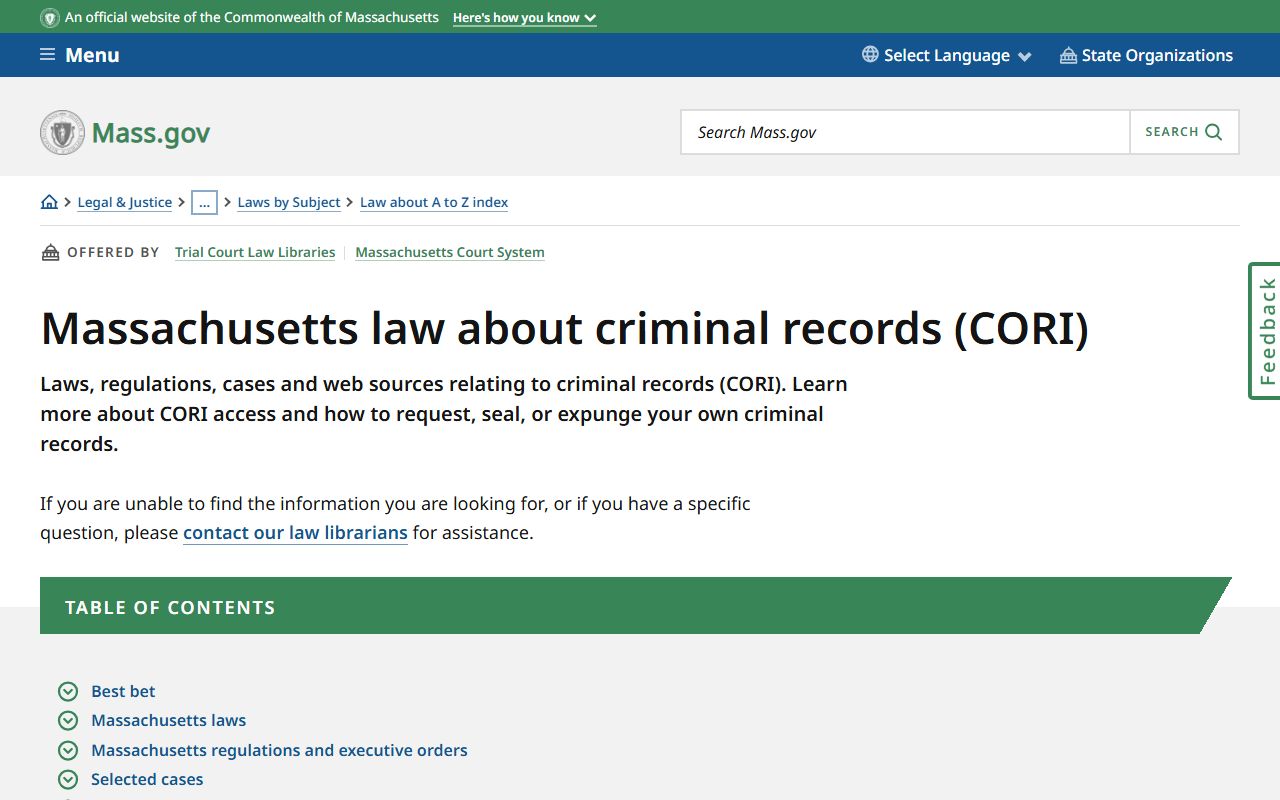
Massachusetts CORI System and iCORI
The CORI system is the core of Massachusetts arrest record access. CORI stands for Criminal Offender Record Information. The state's Department of Criminal Justice Information Services (DCJIS) manages it from 200 Arlington Street, Suite 2200, Chelsea, MA 02150. You can call them at (617) 660-4600. The iCORI online portal at mass.gov/icori lets you search criminal records by name. You must register before you can use it.
Under MGL c. 6, § 167, CORI includes records of criminal charges, arrests, pre-trial proceedings, sentencing, incarceration, and release for anyone 18 or older (17 or older before September 18, 2013). A CORI report shows arrest records, court dispositions, probation and parole status, warrant information, and sex offender registration status where applicable. Records that were sealed, dismissed before arraignment, juvenile records, and civil infractions do not appear. Knowing what the system covers helps you set the right expectations before you search.
A personal iCORI request costs $25. Open access requests cost $50. Results may be immediate or take up to 10 business days. You can download or print the report from your account once it is ready. If you can't access the internet, mail a request to DCJIS at the Chelsea address. Mail requests cost $25 and need a notarized signature and a copy of your photo ID. Access to CORI is governed by MGL c. 6, § 172, which sets waiting periods before certain records become accessible. Misdemeanors drop off after 5 years, felonies after 10 years, and non-conviction records are accessible right away.
MassCourts Electronic Case Access Portal
MassCourts is the Massachusetts Trial Court's free public search tool at masscourts.org. It covers the Boston Municipal Court, District Court, Superior Court, Housing Court, Probate and Family Court, Land Court, Appeals Court, and Juvenile Court to a limited degree. You can search by name, case number, or docket number. No registration is needed. The site runs 24 hours a day.
To search, pick a court department, then choose a specific court location, then type in a name or case number. Results show the case number, parties involved, charges filed, court events, and current status. Closed cases show the disposition. You can see if someone was convicted, found not guilty, or had their case dismissed. Full case documents like motions or evidence are not posted online. Juvenile cases are sealed and not publicly visible. Some older cases may not be in the digital system yet.
MassCourts is the best free tool for finding court records tied to an arrest in Massachusetts. It works well as a starting point. Keep in mind it covers what happened in court, not the original arrest itself. An arrest that did not lead to charges may not appear here. Use iCORI or contact the local police department for arrest-level data.
Massachusetts State Police Records
The Massachusetts State Police is at 470 Worcester Road, Framingham, MA 01702. The main line is (508) 820-2300. The State Identification Section, which handles fingerprint-based checks, operates from 59 Horse Pond Road, Sudbury, MA 01776 at (508) 358-3170.
You can request State Police records through the online portal at mass.gov/public-records-for-the-massachusetts-state-police. Create an account, fill out the request form, and submit it online. You can also track the status and download records once they are ready. Mail requests are accepted as well. Include the date of incident, location, involved parties, and any known report number. Under MGL c. 66, § 10, the agency must respond within 10 business days.
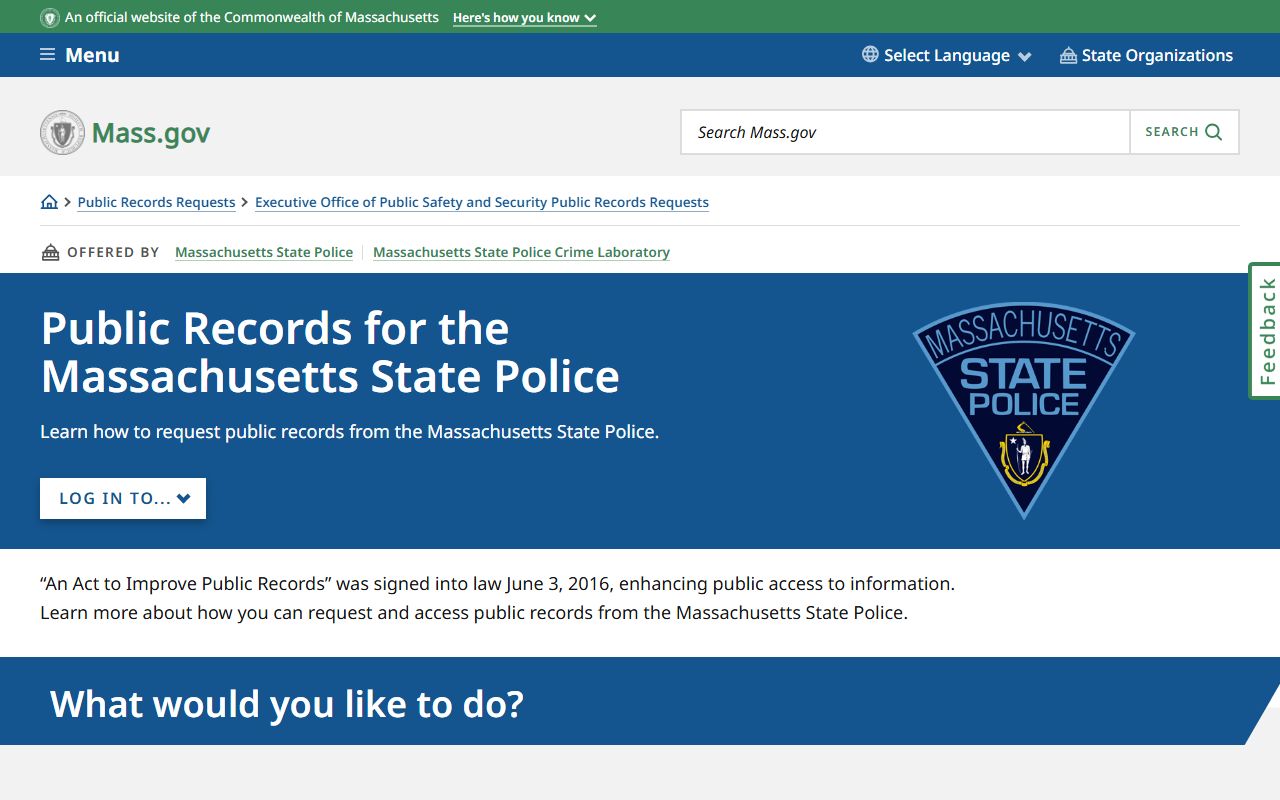
State Police records include incident reports, arrest reports, accident reports, and statistical data. Body camera footage may be available with some restrictions. Records tied to ongoing investigations are generally withheld. Juvenile records and victim or witness identifying information are also exempt.
DOC Inmate Search and County Jails
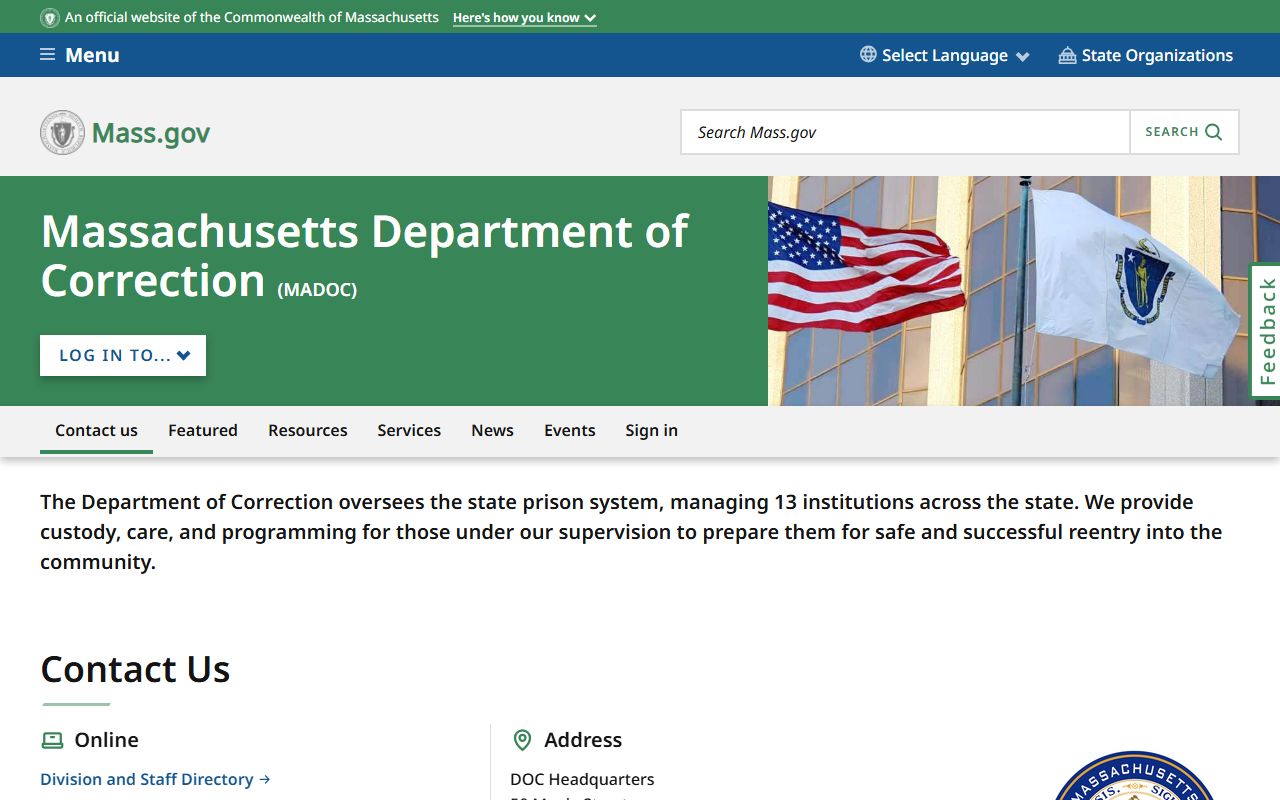
The Massachusetts Department of Correction (DOC) runs a free inmate search at mass.gov/orgs/massachusetts-department-of-correction. Click "Find an Inmate," then search by name or DOC commitment number. Results show the offender's name, commitment number, custody status, and current facility location. Click "More Info" to see date of birth, gender, and offender ID. The search is free and open to anyone. No account is needed.
This tool only covers people currently in state prison. It does not show anyone released, paroled, or held in a county jail. County jails house people awaiting trial and those serving sentences of 2.5 years or less. Each of the 14 Massachusetts counties runs its own house of correction through the county sheriff's office. To find someone in a county jail, contact the relevant county sheriff directly. Contact information for each sheriff is on the county pages linked below.
Sex Offender Registry Board
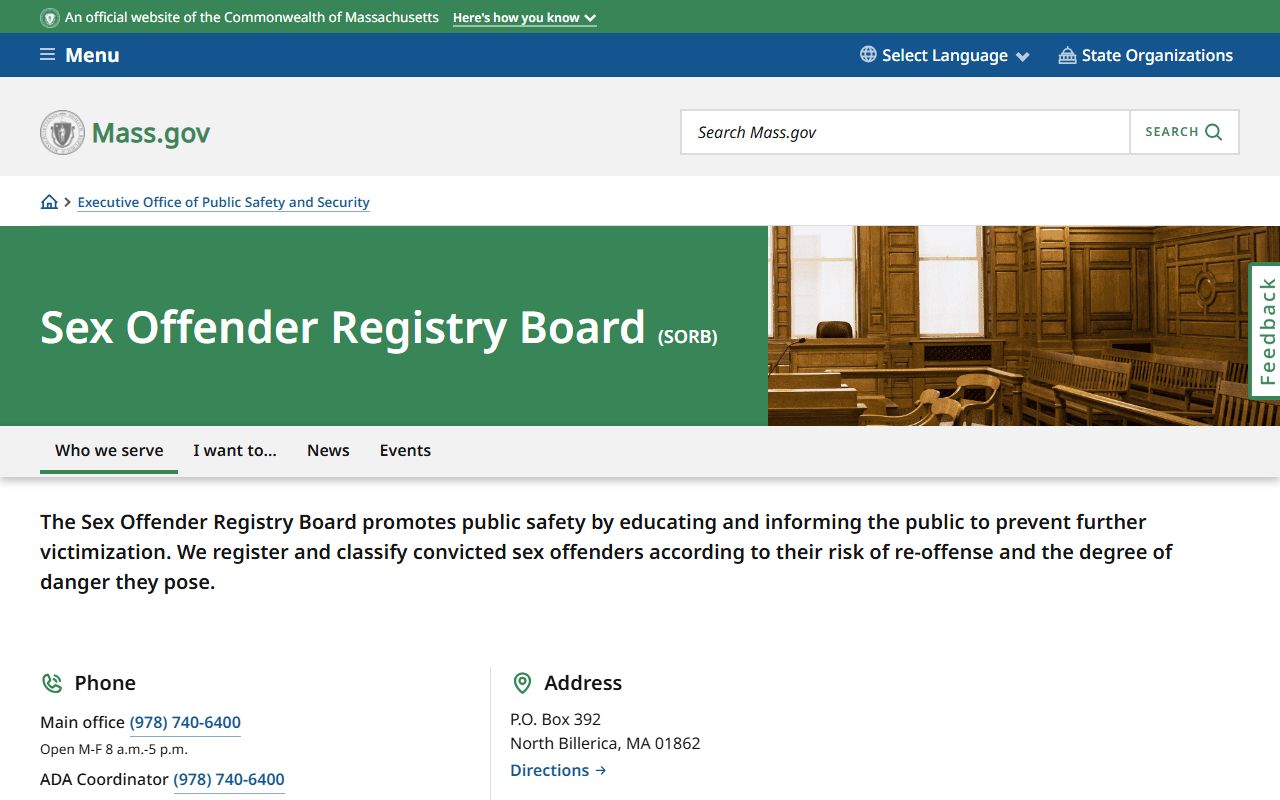
The Massachusetts Sex Offender Registry Board (SORB) is at P.O. Box 392, North Billerica, MA 01862. You can reach them at (978) 740-6400. The public online database is at mass.gov/sorb. Search by name, city or town, zip code, or geographic radius. Results show the offender's name and aliases, current address, photo, physical description, offense history, and risk level.
Massachusetts uses three risk levels for sex offenders. Level 1 offenders are considered low risk. Their records are not public and only go to law enforcement. Level 2 offenders are considered moderate risk. You can ask about them at a local police station but they are not in the online database. Level 3 offenders are considered highest risk and appear in the public search at mass.gov/sorb. Each listing shows work and school locations in addition to home addresses.
Massachusetts Public Records Law
Massachusetts law presumes that public records are open to everyone. Under MGL c. 4, § 7(26), public records are defined as all documents made or received by any government officer or employee, unless a specific exemption applies. The exemptions include personnel and medical files, ongoing investigatory materials, juvenile records, victim and witness identifying information, and records that would endanger public safety. Most arrest records that are not part of an active case fall outside these exemptions and are accessible.
Under MGL c. 66, § 10, government agencies must respond to public records requests within 10 business days. Paper copies cost $0.05 per page. The first two hours of search time are free. After that, agencies can charge up to $25 per hour. Electronic copies must be provided for free if the records already exist in digital form. If an agency denies your request, it must cite the specific exemption that applies. You can appeal a denial to the Supervisor of Records at the Secretary of State's office.
Police logs are a specific type of public record. Under MGL c. 41, § 98F, every police department in Massachusetts must maintain a daily log of incidents. The log must include the time, location, and nature of each incident and must be open to public inspection. Some details are exempt, including information about domestic violence victims under MGL c. 41, § 97D, sexual assault cases, and juvenile incidents.
Note: If an agency denies your records request without citing a specific exemption, you can appeal to the Supervisor of Records through the Secretary of State's office.
Sealing and Expungement of Arrest Records
Massachusetts law gives people ways to limit public access to old arrest records. Under MGL c. 276, § 100A, a person can petition to seal a criminal record. A misdemeanor can be sealed 3 years after completing a sentence. A felony can be sealed 7 years after completing a sentence. No new convictions can occur during that waiting period. A sealed record still exists but does not show up in public searches or iCORI reports.
Non-conviction records seal automatically under MGL c. 276, § 100C. This applies to not-guilty findings, dismissals, and cases where the prosecutor chose not to move forward. No petition is needed. These records are hidden from public view without any action on your part.
Expungement goes further than sealing. Under MGL c. 276, § 100E through § 100U, a court can destroy a record entirely in certain cases. Expungement is available for offenses committed before age 21, cases of mistaken identity, offenses that have since been decriminalized, and records that were created because of errors or fraud. An expunged record does not appear in any search, including law enforcement checks.
How to Request Massachusetts Arrest Records
Start by figuring out which agency has the records you need. For a specific arrest, contact the police department in the city or town where it happened. Ask for the Records Division. Give them the date of the incident, the location, and the names of any people involved. Many departments accept walk-in requests, phone calls, and mail. Some have online portals. Boston has a full online portal at boston.gov/departments/public-records, where you can submit a request, get a tracking number, and check the status online.
To make a formal request under MGL c. 66, § 10, write a letter to the Records Access Officer at the agency. State clearly that you are making a request under the Massachusetts Public Records Law. Describe the records you want in as much detail as you can. Include your name and contact info. You do not need to say why you want the records. Send the letter by email or mail and keep a copy. The agency must respond within 10 business days.
Lowell Police records are available until midnight, Monday through Friday, at the Records Division main desk. The fee is $1 per report. Lowell's Records Division email is records@lowellpolice.org and the phone is (978) 674-4508. Springfield maintains a 7-day rolling arrest log on its website at springfield-ma.gov/police that shows names, dates, charges, and status. These are examples of the variation you'll find across departments in Massachusetts.
Note: Domestic violence reports are protected under MGL c. 41, § 97D and are not available to the general public regardless of who makes the request.
Browse Massachusetts Arrest Records by County
Each of Massachusetts's 14 counties has its own sheriff, courts, and police departments. Pick a county below to find local resources, contact information, and search tools for arrest records in that area.
View All 14 Massachusetts Counties
Arrest Records in Major Massachusetts Cities
City police departments are the first source for local arrest records. Pick a city to find the police department's contact info, records request process, and other local resources.